
Chief Economic Advisor V Anantha Nageswaran highlights the challenges of digital access, data governance, interoperability, and cyber security in India's digital public infrastructure (DPI), despite its world-class scale.

Indian banks and non-banking financial companies (NBFCs) are undertaking a comprehensive review and reset of their engagement terms with fintech firms, driven by the Reserve Bank of India's (RBI) draft Guidance on Regulatory Expectations for Data Governance and the stringent compliance requirements of the Digital Personal Data Protection (DPDP) Act, 2023, and its 2025 Rules.

A new report reveals that enterprise AI investment in India has surged by 119 per cent, exceeding the global average. However, only 22 per cent of Indian organisations have established adequate governance frameworks, creating a significant gap between rapid deployment and safe, scalable AI adoption. This lack of governance impacts operational depth and raises concerns about transparency, regulation, and data privacy.

NITI Aayog has recommended treating data centres as strategic infrastructure rather than mere investment projects, releasing a report titled 'Data Centre Evaluation Framework to Help States Plan for Sustainable Growth'. The report advocates for common standards, central government guidance, and a structured approach for states to manage data centre growth, considering resource requirements and economic benefits.
Industry experts advocate for India to develop its own artificial intelligence (AI) safety framework, distinct from US or EU models, to address unique challenges like deepfakes and cyberattacks. They call for a comprehensive commitment involving all stakeholders and a hybrid regulatory approach combining voluntary and binding measures, as the Indian government also considers new AI regulations.

The Delhi government has signed a Memorandum of Understanding with EkStep Foundation to transform its administrative data into an AI-ready format. This initiative aims to improve governance, enhance public service delivery, and enable proactive, evidence-based decision-making by leveraging artificial intelligence.

India's cybersecurity agency, CERT-In, has issued a critical advisory warning about autonomous AI agents accessing sensitive data of Indian organisations without authorisation. Government sources on Friday emphasised the need for companies to bolster cybersecurity measures and monitor system activity, noting that while no major compromise occurred, the incident serves as an early warning. Future AI regulation is expected to address the risks posed by these agents.

The Government of Karnataka has called for enhanced collaboration with the BFSI and FinTech sectors to bolster its technology ecosystem and accelerate the adoption of innovative solutions. This initiative, discussed at an Industry Meet, aims to foster partnerships between government, industry, and academia, particularly through programmes like 'Government First', in preparation for the Bengaluru Tech Summit 2026.

The Securities and Exchange Board of India (Sebi) is set to undertake a comprehensive overhaul of the small and medium enterprise (SME) listing framework and tighten accountability around the use of artificial intelligence (AI) and machine learning (ML) in financial markets, Sebi Chairman Tuhin Kanta Pandey announced.

India's government has implemented stringent new regulations under the Telecommunications Act 2023, mandating that all communication infrastructure providers, including those utilising cloud-based networks, must store telecommunication data exclusively within the country, a move expected to significantly impact domestic data centre demand.

The CEO of the National Health Authority, Sunil Kumar Barnwal, highlighted BRICS nations' shared aspiration for connected, patient-centric, and resilient healthcare systems through digital health infrastructure and responsible AI. Discussions at the 16th BRICS Health Ministers' meeting focused on overcoming challenges like limited interoperability and workforce constraints, with countries like Brazil and Indonesia sharing successful digital health initiatives.

An innovation roadmap, a mechanism to double annual bilateral trade within next five years, and a joint artificial intelligence framework were among 13 outcomes to emerge from wide-ranging talks between Prime Minister Narendra Modi and President Emmanuel Macron on Sunday.

The Indian government has strongly refuted Elon Musk's allegations that Starlink's satellite communication services are being blocked in the country, asserting that a fair and non-discriminatory regulatory framework is in place for all telecom providers. The government emphasised that compliance with security norms is mandatory for all licensees, including Starlink, Jio Satcom, and Eutelsat OneWeb, all of whom are currently undergoing security assessments.

A data breach does not end when the headlines fade. For victims, stolen personal information can fuel fraud, identity theft and financial losses for years.

Sikkim has identified 40 high-hazard glacial lakes, with 16 at the highest risk of catastrophic outbursts. Following a devastating GLOF in 2023, the state is developing India's first dedicated GLOF Risk Mitigation Protocol, using advanced monitoring and interdisciplinary approaches to protect downstream settlements and serve as a model for other Himalayan regions.

The proposal caught auto makers by surprise.

The Supreme Court has directed the Centre to explore a statutory framework to ensure social media intermediaries comply with Indian laws regarding minors, particularly concerning their inability to independently enter into contracts. The court highlighted the need for safeguards to protect children from potential harms on digital platforms, including exploitation and misuse of data, and asked the Solicitor General to examine incorporating these requirements into intermediary rules.

Prime Minister Narendra Modi has urged for a global framework to combat cross-border cyber frauds and deepfakes, highlighting the need for governments, tech companies, telecom operators, and financial institutions to collaborate. Speaking at the India Mobile Congress 2026, Modi stressed that technology thrives on trust and that India is ready to share its expertise in tackling cyber threats. He also noted the rapid expansion of 5G and the success of digital governance initiatives like Direct Benefit Transfer.

His remarks come amid a debate over whether Tata Sons, the holding company of India's largest conglomerate Tata group, is required to go public.
The Karnataka government has formed a committee on responsible AI to develop a framework for the safe, ethical, and transparent adoption of AI across government systems and public services.
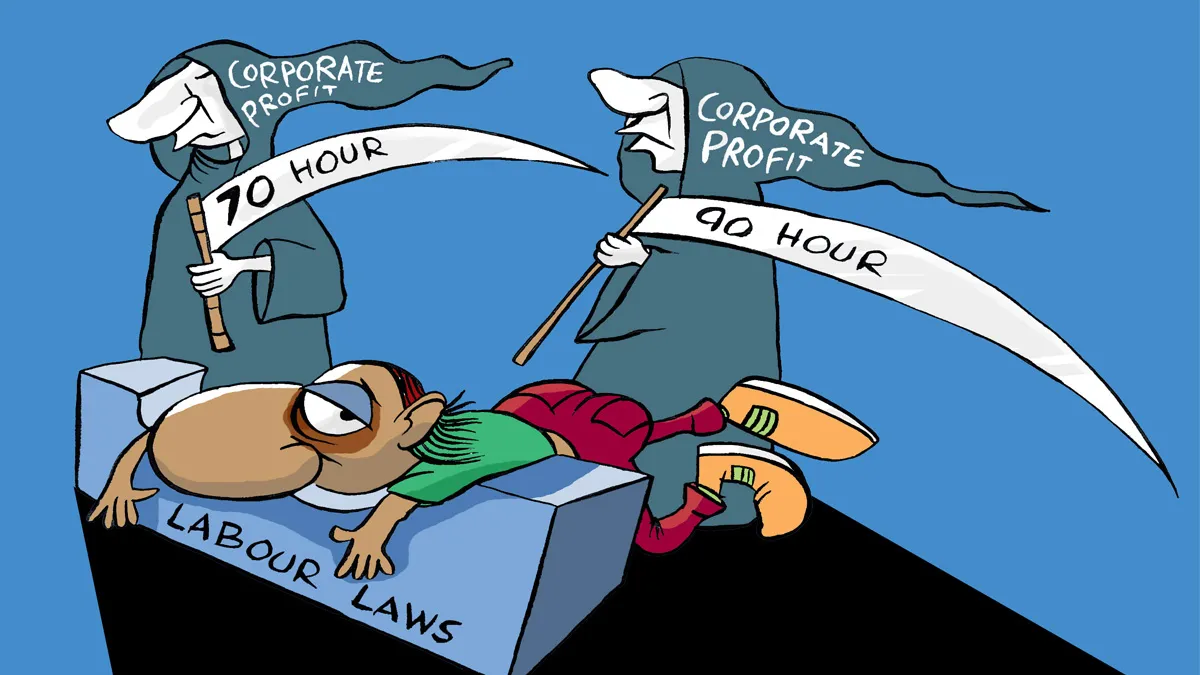
The Indian government is pressing all states and Union Territories (UTs) to publish their rules under the four new labour Codes by October 31, aiming to fully operationalise the new labour law framework. This move is crucial as labour falls under the concurrent list, requiring state-level rule-making for effective implementation.

Experts at a national symposium in Shillong discussed the role of Artificial Intelligence in tourism, emphasising that AI should support human judgment, local knowledge, and cultural values rather than replace them. Discussions highlighted the need for robust policies to address ethical concerns, safeguard livelihoods, and preserve cultural heritage while leveraging AI for innovation and sustainability in the tourism sector, particularly in Meghalaya.

India's Ministry of Electronics and Information Technology (MeitY) has sought an explanation from WhatsApp regarding its username feature, citing concerns over potential cybercrime facilitation. Concurrently, the ministry is investigating reported data leak allegations involving Tata Electronics, a key supplier for Apple's iPhone components in India. MeitY is also exploring techno-legal solutions for VPNs to address challenges posed by unregistered providers operating from outside India.

Airtel Business CEO Sharat Sinha stated that evolving architecture and methodologies for safely deploying Artificial Intelligence, coupled with adequate guardrails, are essential to unlock productivity gains. He welcomed the government's upcoming consultation paper on AI regulation, focusing on safety, deepfakes, and a human-first approach. Sinha also highlighted AI's role in driving demand for digital infrastructure and Airtel's growth in cybersecurity and fraud prevention.

A new report by ADP reveals that one in two Indian companies plan to adopt AI-powered payroll systems within the next 12 months, driven by the need for automation in workforce management, compliance, and compensation decisions. However, firms are increasingly cautious about data protection risks, especially with the implementation of the Digital Personal Data Protection (DPDP) Act, 2023.

A Public Interest Litigation has been filed in the Supreme Court challenging the Centre's decision to impose a 0.4 per cent Merchant Discount Rate (MDR) on UPI person-to-merchant transactions exceeding Rs 2,000. The plea argues that the levy was introduced without adequate statutory safeguards, transparency, or public consultation, and questions its constitutional validity and potential adverse effects on merchants and consumers.

The Supreme Court has refused to grant an interim stay on the imposition of Merchant Discount Rate (MDR) on UPI person-to-merchant transactions exceeding Rs 2,000, which is set to take effect from October 15. The court has agreed to examine the challenge to this new fee and has issued notices to the Centre, RBI, and NPCI, seeking their responses within four weeks. A Public Interest Litigation (PIL) argues that the levy lacks statutory safeguards, transparency, and public consultation, and could adversely affect merchants and consumers.

The Goods and Services Tax (GST) Council is set to discuss proposals aimed at transforming the complex indirect tax system into a more business-friendly regime, focusing on simplifying compliance, reducing administrative burdens, and potentially raising the prosecution threshold.

The Supreme Court expressed dissatisfaction with the Centre's cap on anti-cancer drug trade margins, questioning why similar controls aren't applied to other medicines. The court highlighted significant markups on common drugs and medical devices, urging the government to expand its price regulation efforts and present modalities by October 27.

India's GST Council has approved changes allowing small online sellers to register in states without physical premises by using an e-commerce operator's warehouse as their principal place of business, aiming to boost national sales for small businesses.

India's newly formed Artificial Intelligence Governance and Economic Group (AIGEG) is set to advocate for a unified legal framework for AI companies, including developers of large language models and chatbot systems, alongside broader operational rules.

India has secured a spot among the top 10 leading emerging-market performers in artificial intelligence (AI) readiness, with private investment in AI more than tripling to USD 4.1 billion in 2025, according to a new World Bank report.

The Securities and Exchange Board of India (Sebi) has proposed a new framework to manage strike prices for options contracts, aiming to ensure continuous availability of suitable contracts even during sharp intraday market swings. This move addresses concerns that extreme price movements can leave traders without appropriate options for hedging or positioning.

The Maharashtra government has declared 265 out of 358 talukas as drought-affected, covering 74% of the state, due to significant rainfall deficit. This declaration activates 'Trigger-1' of the state's drought management framework, leading to the announcement of various relief measures for farmers and residents, including loan restructuring, revenue concessions, and provisions for water and fodder.

The Union Cabinet has approved a significant increase in the mandatory EPFO wage ceiling from Rs 15,000 to Rs 25,000 per month, a move expected to bring over 51 lakh additional employees under mandatory social security coverage.

Former Bombay High Court judge Justice R C Chavan has resigned from the Maharashtra government's Uniform Civil Code panel, citing profound concerns.

India is strategically positioned to develop a robust domestic semiconductor ecosystem, driven by increasing electronics consumption, strong government support through incentives, and a global shift in supply chains. Boston Consulting Group Managing Director Ankush Wadhera highlights India's potential as a safe haven for investments, with the AI boom further fuelling demand for advanced chips. The nation aims to expand its capabilities across the entire semiconductor value chain, attracting significant global and domestic investments.

The NCP (SP) has demanded a complete rollback of the 0.4 per cent Merchant Discount Rate (MDR) on UPI transactions above Rs 2,000, effective October 15. The party termed the move a "direct assault" on small traders and shopkeepers, accusing the Modi government of "double standards" by burdening small merchants while large industrialists benefit from loan write-offs.
The Finance Ministry has clarified that the decision to impose a 0.4% Merchant Discount Rate (MDR) on UPI transactions above Rs 2,000 was made independently, refuting claims of foreign influence. The ministry stated the policy aims to build a self-sustaining digital payments ecosystem, with MDR funding infrastructure and supporting small merchants.
India's mining sector is shifting from sustainability compliance to a data-driven model focused on long-term performance, driven by evolving ESG regulations and digital compliance, according to a Deloitte-ICC report.
